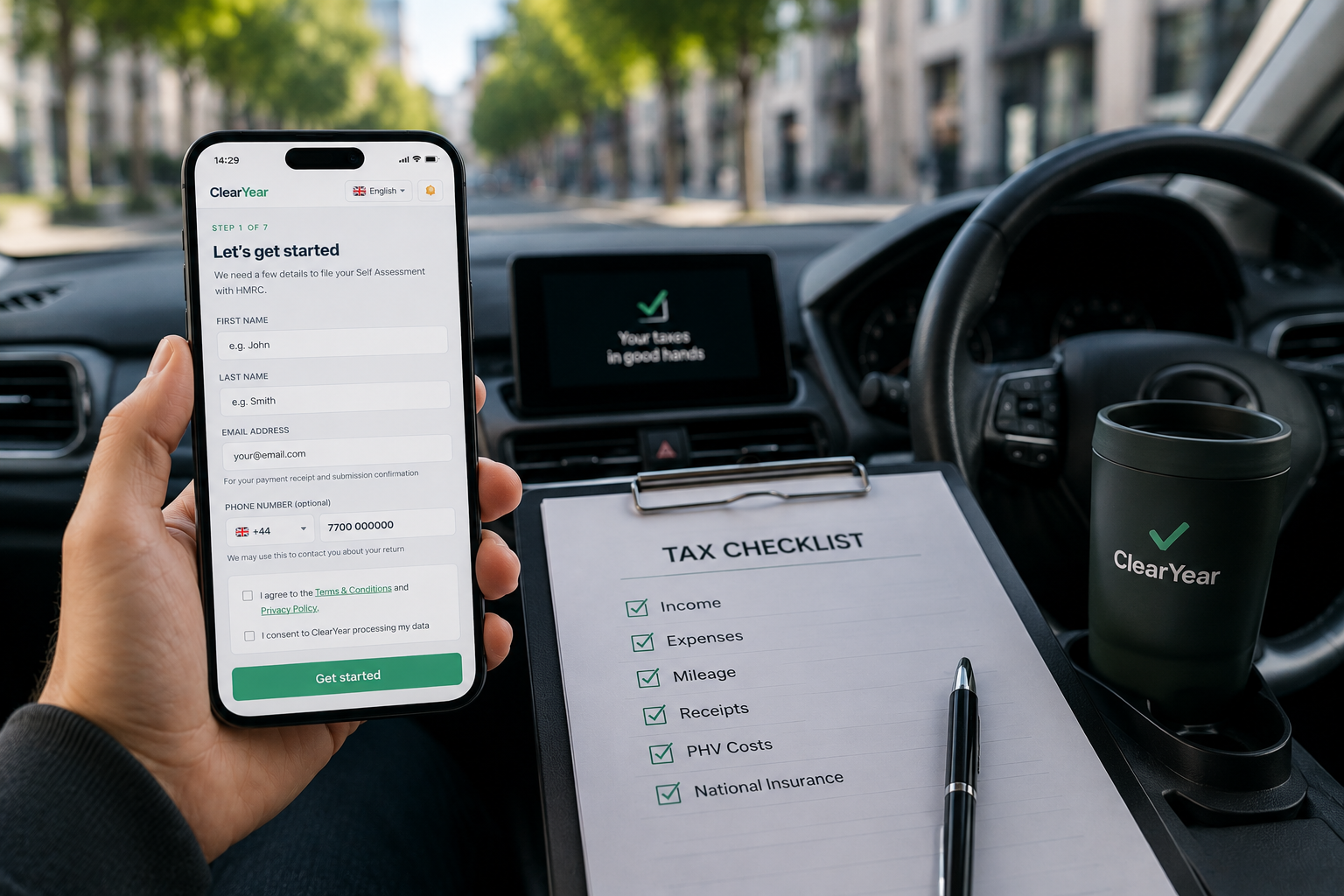
If you drive for Uber, Bolt, Ola, or any other rideshare platform in the UK, HMRC doesn't see you as an employee of that company — it sees you as self-employed. That single fact changes everything about how your tax works, and it catches a lot of drivers off guard in their first year.
Why you're self-employed, not an employee
Rideshare platforms don't pay you a salary, don't deduct tax through PAYE, and don't give you a payslip in the traditional sense. You choose your own hours, use your own vehicle, and take on the financial risk of the work — all signs HMRC uses to classify you as self-employed rather than an employee.
This means the responsibility for declaring your income and paying the right tax sits with you, not with Uber or Bolt.
Do you actually need to register?
If your self-employment income (before expenses) is over £1,000 in a tax year, you need to register for Self Assessment with HMRC and file a tax return. If you're already registered from a previous year, you don't need to register again — just file as normal.
The £1,000 figure is your gross income from driving, not your profit. Even if your actual profit after expenses is much lower, the registration threshold is based on the income before deductions.
What counts as income
Your income for tax purposes is everything the platform pays you — fares, tips passed through the app, and any bonuses or incentive payments. Some platforms deduct their commission before paying you; what matters for your tax return is usually the gross fare amount, with the platform's commission then claimed back as an allowable expense (your app's earnings statement or the platform's own tax summary usually breaks this down clearly).
What you can claim as expenses
This is where most drivers either overpay tax by not claiming enough, or get it wrong by claiming things they shouldn't. Common allowable expenses include:
- Vehicle running costs — fuel, insurance, servicing, and repairs (if using actual costs rather than mileage)
- Mileage — a flat rate per mile if you choose the simplified mileage method instead of actual costs
- Platform commission and booking fees
- Phone costs, if used for the app (the business-use portion only)
- Cleaning and valeting costs for the vehicle
- Parking and toll charges incurred while working
Important: you can't claim both mileage and actual vehicle running costs for the same vehicle in the same year — you have to pick one method and stick with it.
What about PHV licensing costs?
Private hire vehicle licence fees, DBS checks, and any council-required medical or driving assessments related to your PHV licence are generally allowable as business expenses, since they're a direct cost of being able to legally do the work.
National Insurance
As a self-employed driver, you'll typically pay Class 4 National Insurance on your profits above a certain threshold, calculated automatically as part of your Self Assessment. You may also need to pay Class 2 National Insurance depending on your profit level, which affects things like your State Pension entitlement.
What happens if you don't file?
Missing the Self Assessment deadline (31 January following the end of the tax year) triggers an automatic £100 penalty from HMRC — even if you don't actually owe any tax. The longer you leave it, the more the penalties and interest add up.
The bottom line
Driving for Uber or Bolt makes you self-employed in HMRC's eyes from day one. The good news is that once you know what counts as income and what you can claim back, the actual filing itself is usually straightforward — you're reporting turnover, deducting genuine expenses, and declaring the profit.