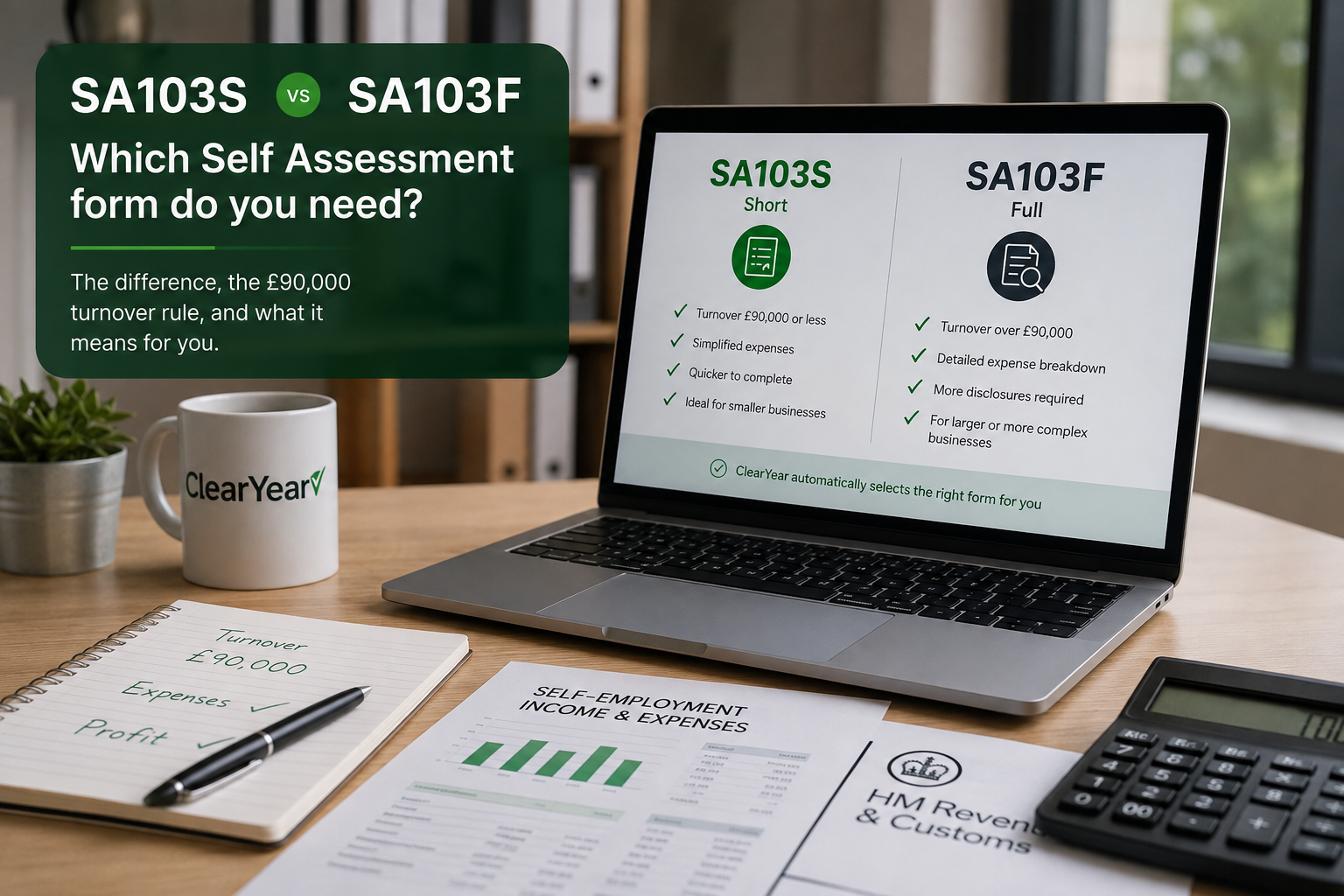
If you're self-employed and filing a UK Self Assessment tax return, your self-employment income and expenses go on one of two supplementary forms: the SA103S (Short) or the SA103F (Full). Which one you need isn't a matter of choice — it's determined by your turnover.
The short answer
If your annual turnover from self-employment is £90,000 or less, you use the SA103S. If it's above £90,000, you're required to use the SA103F. This threshold is the same as the VAT registration threshold, which is why it's used as the cutoff point here too.
What "turnover" means in this context
Turnover is your total business income before any expenses are deducted — not your profit. A business with £95,000 in turnover but only £20,000 in actual profit after expenses still needs the SA103F, because the threshold is based on turnover, not profit.
SA103S — the short version
The SA103S is a simplified version, asking for:
- Total turnover for the year
- Total allowable expenses (as a single combined figure, or broken into a few broad categories)
- Any capital allowances
- Basic details about your business
It's designed to be quick to complete for smaller, simpler self-employment situations.
SA103F — the full version
The SA103F asks for significantly more detail, including:
- A full breakdown of expenses by category (cost of goods, wages, rent, motor expenses, professional fees, and more, itemised separately rather than combined)
- Balance sheet information in some cases
- More detailed capital allowances and disposals
- Additional disclosures around accounting methods and any changes to your business
It takes longer to complete, but gives HMRC — and you — a clearer, itemised picture of exactly where your income and costs come from.
Can you choose to use the full form even under £90,000?
Yes. There's nothing stopping you from using the SA103F even if your turnover is under the threshold, if you'd prefer to itemise your expenses in more detail. Some people with more complex expense categories choose to do this even when the short form would technically be sufficient. What you can't do is use the SA103S if your turnover is over £90,000 — that direction only works one way.
What happens if you use the wrong one?
Using the SA103S when your turnover is actually over £90,000 is a common mistake that can lead to HMRC querying your return, or in some cases treating it as an incomplete submission. It's worth double-checking your total turnover figure before filing, particularly if you're close to the threshold.
How this is handled automatically
The good news is you don't need to remember any of this or track down the right form yourself — when you file through ClearYear, the correct form (SA103S or SA103F) is selected automatically based on the turnover figure you enter, and populated for you as part of your submission.